Will AI replace call center jobs in India?
It’s a question millions of professionals are asking as automation transforms the global outsourcing industry.
India’s call center sector has long been a symbol of reliable human support, employing over five million people and contributing billions to the economy.
But today, AI-driven automation and voice bots are beginning to reshape how customer service operates, making it faster, cheaper, and more efficient than ever.
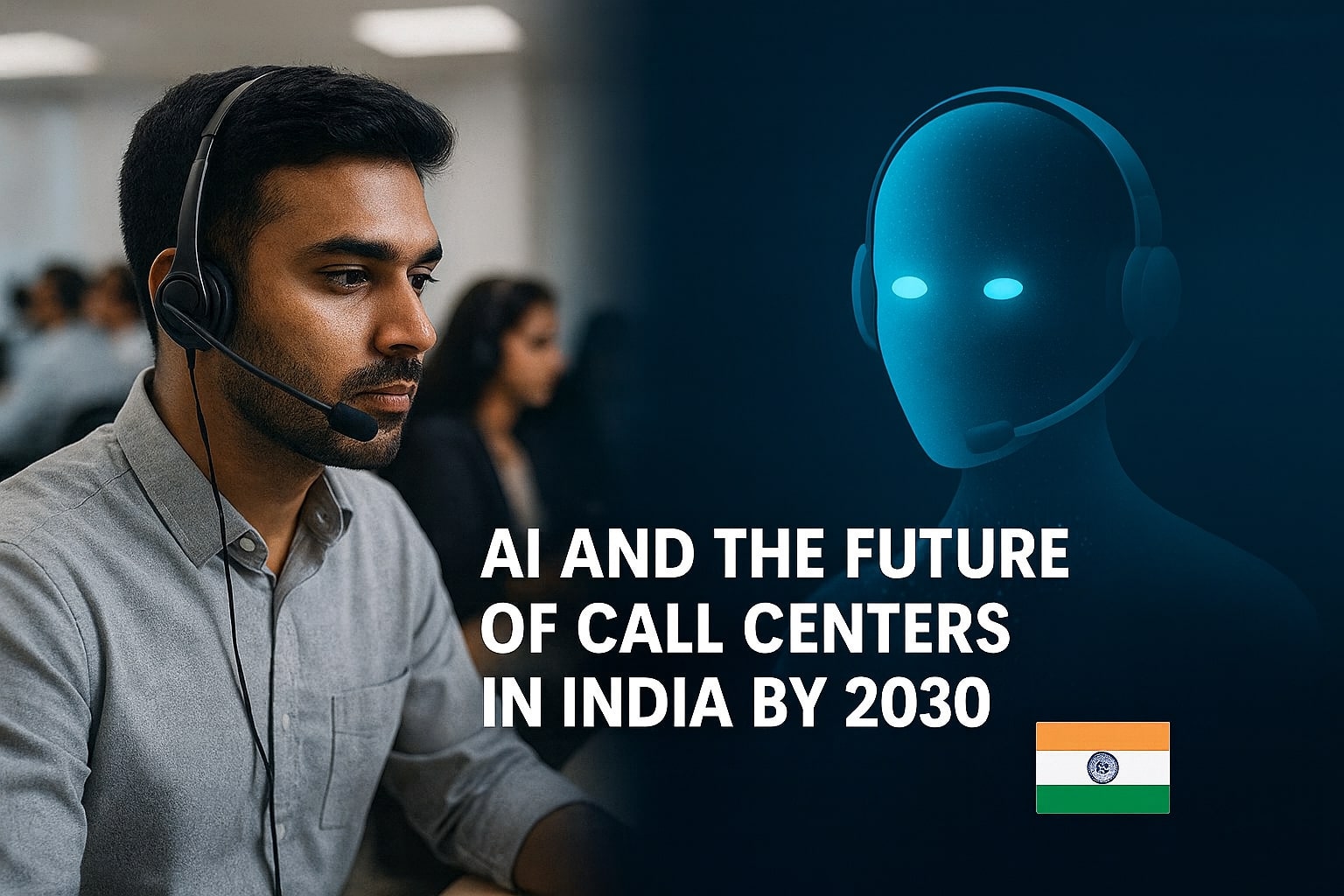
So, does this mean that by 2030, telecalling and customer service jobs will vanish? Let’s explore the data, trends, and opportunities that lie ahead.
India’s BPO Sector and the Rise of Voice AI
Over the last decade, India became the world’s outsourcing capital, from IT support to customer care. However, recent advances in voice AI are beginning to automate large portions of the process.
AI systems like Yellow.ai, Rezo.ai, and OpenAI’s Voice Engine can understand natural speech, detect sentiment, and respond in regional accents. They handle order tracking, balance inquiries, appointment scheduling, and even emotional customer responses, tasks that once needed hundreds of agents.
According to a 2025 Deloitte Insights article, 40 % to 60 % of routine work activities across industries can be automated by AI, which strongly suggests that many roles in the call-centre sector could face elevated automation risk.
These innovations show how AI is starting to replace call center jobs in India, especially for repetitive customer service functions.
How AI Is Changing Customer Support Jobs
Automation in call centers is no longer theoretical.
Here’s what’s happening right now:
- AI-based call routing reduces human involvement in transferring calls.
- Speech recognition helps detect tone and urgency in a caller’s voice.
- Chatbots and voice assistants handle FAQs 24/7 without breaks.
- Real-time analytics track performance and generate summaries for managers.
According to OpenAI’s research on conversational AI, voice models are already capable of handling multilingual support and sentiment-based routing.
Companies adopting these tools report shorter call times, lower costs, and better accuracy, but it also means fewer humans are needed for repetitive calls.
AI Job Risk Score: Telecaller & Call Center Executive
According to our AI Job Risk Calculator, the AI replacement risk for Telecaller and Call Center Executive roles is 78% (High).
Safe: ❌ Not Fully Safe
Why these roles are vulnerable:
- Tasks are repetitive and rule-based.
- Customer scripts are easy for AI to learn and replicate.
- Companies prefer scalable, always-available AI agents.
This doesn’t mean every telecaller will lose their job overnight, but it does show how exposed this role is compared to other service professions.
Why Call Center Jobs Are Most at Risk
1. High Volume of Routine Work
Most call center interactions follow strict scripts, including greeting, query, response, and closure.
AI can replicate this structure efficiently and in multiple languages. Once trained, it delivers identical quality across thousands of calls.
2. Cost Savings
An AI voice system costs less than maintaining a team of agents. It can handle millions of calls simultaneously, without salary hikes or sick days.
Businesses see an immediate return on investment when they deploy AI for high-volume tasks.
3. 24/7 Consistency
Unlike humans, AI doesn’t tire or make emotional errors. It maintains tone and compliance across every call.
For companies aiming for global operations, this consistency is invaluable.
This is why experts predict that AI could replace a significant portion of call center jobs in India by 2030, particularly in voice-based operations.
Which Call Center Roles Will Survive
Not every role is disappearing. Jobs that require human understanding, problem-solving, and empathy will remain essential.
Likely to stay relevant:
- Client Relationship Managers: handle escalations and personal communication.
- Quality Analysts: monitor AI call accuracy and compliance.
- AI Support Supervisors: manage voice bot performance and updates.
- Multilingual Support Specialists: handle cultural nuances AI cannot interpret.
As automation grows, human expertise will move toward oversight and customer relationship management rather than basic query handling.
Real Examples: AI in Indian Call Centers
Several Indian companies are already using AI to manage calls:
- Tech Mahindra has introduced voice bots that manage up to 60% of inbound support for BFSI clients.
- Infosys BPM is testing multilingual conversational AI for global clients.
- HDFC Bank and Airtel now use AI voice assistants for initial screening before routing customers to human agents.
These case studies highlight how AI is already replacing parts of India’s call center workforce, though full automation is still years away.
These pilots show that AI isn’t replacing humans overnight; it’s being integrated gradually to improve efficiency.
Still, as adoption grows, the overall demand for entry-level telecalling jobs is expected to decline.
What Telecallers Can Do to Stay Relevant
If you’re working in customer service, the best strategy is adaptation, not fear.
Here’s how to future-proof your career:
- Learn to work with CRM and AI tools such as Zoho Desk, Salesforce, and Freshdesk.
- Develop communication and soft skills that AI cannot replicate, such as empathy, negotiation, problem resolution.
- Upskill in data and analytics to monitor AI performance or customer satisfaction metrics.
- Explore hybrid roles, like AI support specialist, chatbot trainer, or sales operations executive.
A call center professional who understands both people and technology will always stay in demand.
👉 Explore our Future-Proof Careers section to find jobs least affected by AI.
The Road Ahead: Humans and AI Working Together
By 2030, AI will be a normal part of every customer support department.
It will handle repetitive work, while humans focus on building trust and solving complex issues.
Instead of fearing replacement, professionals can prepare for AI-assisted workplaces, where success depends on learning new tools, managing AI interactions, and improving customer experience.
As India continues to lead the global outsourcing market, those who adapt early will find more opportunities than losses.
Rather than fearing that AI will replace call center jobs in India completely, professionals should focus on learning AI tools and hybrid customer roles that complement automation.
Key Takeaways — AI’s Impact on Telecalling Jobs
- AI replace call center jobs in India: 78% (High Risk)
- Routine and scripted roles are most likely to be automated.
- Human-centered roles like client management will continue to grow.
- Upskilling in AI tools and communication is essential for long-term career safety.
- AI will not remove all jobs; it will change how they’re done.
Conclusion
AI will certainly change the future of India’s call center industry, but it’s not the end of human involvement.
The industry will move from repetitive, script-driven conversations to intelligent, empathy-based communication supported by AI tools.
While AI may replace call center jobs in India at the entry level, For professionals who stay updated and adaptable, the future still holds plenty of opportunities.
The key is simple: don’t fight AI, learn to work with it.
Similar trends are also reshaping Data Entry roles 👉 see how AI is replacing Data Entry jobs (2025–2035 outlook).
FAQ
Q1. Will AI completely replace telecalling jobs by 2030?
No. AI will automate a majority of simple and repetitive calls, but human agents will still be needed for complex cases and customer relationships.
Q2. Which Indian companies are already using AI in call centers?
Tech Mahindra, Infosys BPM, HDFC Bank, and Airtel are among the companies using AI voice bots to improve efficiency and handle basic customer queries.
Q3. What is the AI risk score for telecalling jobs?
According to the AI Job Risk Calculator on AIJobRisk.in, Telecaller and Call Center Executive roles have an AI risk score of 78% (High).
Q4. How can telecallers future-proof their careers?
By learning CRM tools, developing communication and empathy skills, and upskilling into hybrid roles such as AI quality analysts or chatbot trainers.