Future-proof careers for non-coders in India are rising fast as AI transforms workplaces and automates repetitive technical tasks.
Artificial Intelligence is changing the way people work across every industry.
Each month, new AI tools make our tasks faster and more efficient.
But there’s a question on many minds: “Will I lose my job if I don’t know coding?”
Here’s the good news – you don’t need to be a programmer to have a secure and successful career in the age of AI.
In fact, many of the most stable and growing roles in India depend more on problem-solving, creativity, and communication than on technical coding skills.
This article explores the best future-proof careers for non-coders that will thrive between 2025 and 2035, why they’re safe, and how you can prepare for them.
Why Non-Coders Still Have a Bright Future in the AI Era
AI can handle repetitive tasks, but it struggles with understanding people, making ethical decisions, and thinking creatively.
That’s where human professionals stand out.
Skills such as empathy, communication, leadership, and critical thinking are becoming even more valuable.
In India, fields like education, marketing, healthcare, and design are already using AI tools, but they still need humans who can think, interpret, and lead.
For example:
- A digital marketer might use ChatGPT to plan campaigns but still decides what connects with customers.
- A project manager may track progress with AI dashboards but guides the team personally.
- A designer can use Figma AI for layouts but adds the emotional touch only humans can provide.
AI is not replacing these professionals, it is helping them work smarter.
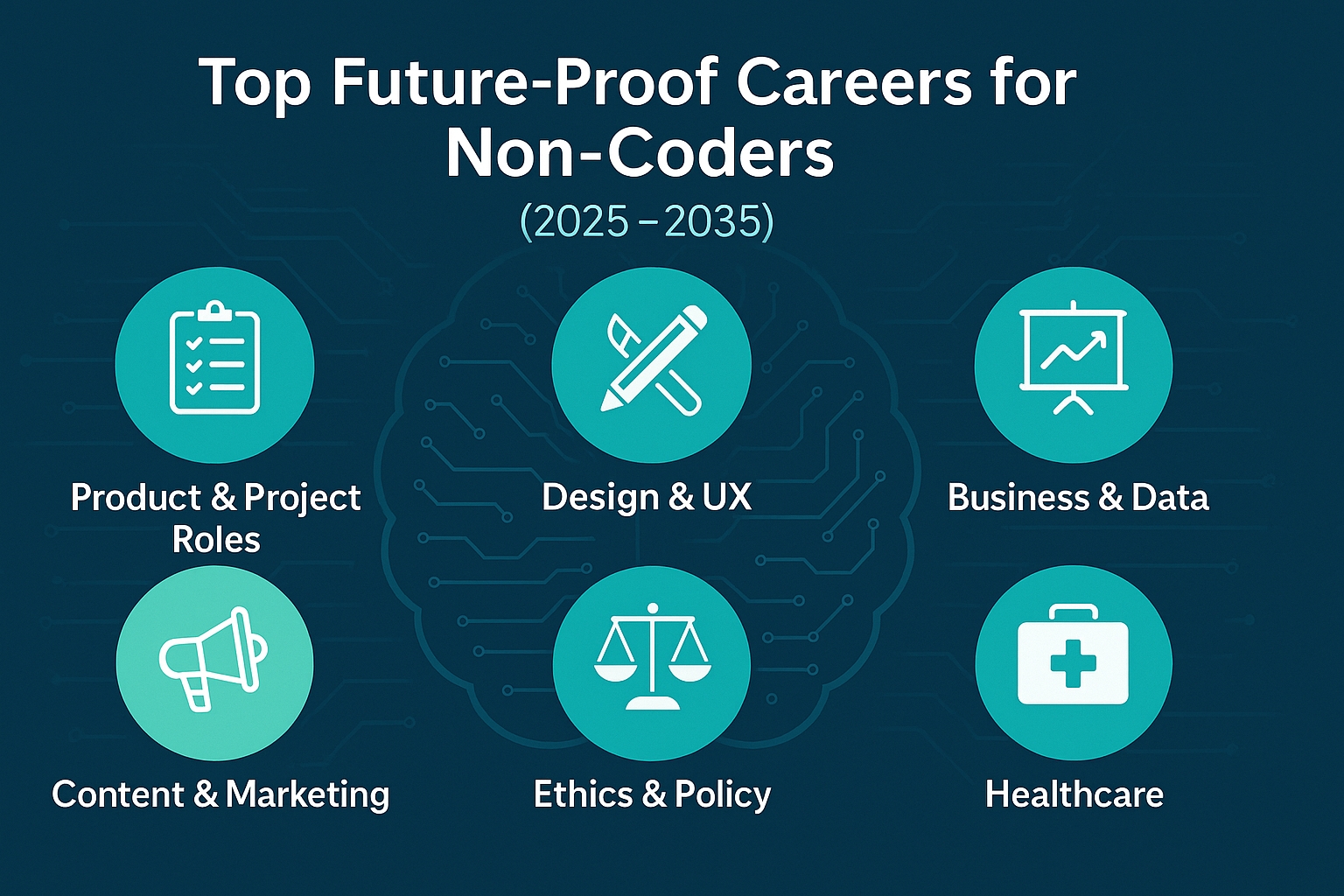
Top 10 Future-Proof Careers for Non-Coders (2025–2035)
Below are ten careers that are growing fast and will stay in demand, even as AI becomes part of daily work.
1. Product Manager (AI-Driven Projects)
Product managers plan and guide a product from idea to launch. They coordinate between developers, designers, and business teams, and no coding required.
Their main skills are strategy, communication, and leadership.
With India’s startup boom and the rise of AI-powered apps, product managers who understand technology (without coding) will always be valuable.
- How to start: Learn product management, agile methods, and user research using tools like Jira or Trello.
- Average Salary in India: ₹12–40 LPA (varies by company and city).
- Future Demand (2025–2035): Very High
- Reason: More companies are building AI-powered apps, and they need product managers to connect business goals, user needs, and technology.
2. UX/UI Designer and Researcher
UX (User Experience) designers make digital products easy and enjoyable to use. Even though design tools are adding AI features, creativity and human insight will always be essential.
India’s app and digital service industries are growing quickly, creating strong demand for UX designers.
- How to start: Learn design thinking, user psychology, and software like Figma or Adobe XD.
- Average Salary in India: ₹6–22 LPA depending on experience.
- Future Demand: High
- Reason: Digital apps are growing everywhere. AI can help with design, but only humans understand emotions, behavior, and good user experience.
3. Business Analyst / Data Interpreter
Business analysts help companies make better decisions using data.
They don’t write code; instead, they use tools like Excel, Power BI, or Google Data Studio to find patterns and insights.
AI can process data faster, but humans are still needed to interpret what it means and how to act on it.
- How to start: Learn data visualization, analytics, and reporting tools.
- Average Salary in India: ₹5–18 LPA with strong growth in tech companies.
- Future Demand: Very High
- Reason: Businesses generate tons of data, but humans are needed to make sense of it and guide decisions.
4. Digital Marketing Strategist
AI can generate text and images, but understanding people, what they want and how they think is something only humans can do.
Digital marketers who learn to combine AI tools with human creativity are already ahead of the curve.
India’s digital marketing sector is expected to cross ₹50,000 crore by 2030, so opportunities will only increase.
- How to start: Learn SEO, social media strategy, and analytics tools like Google Analytics or SEMrush.
- Average Salary in India: ₹4–15 LPA plus performance incentives.
- Future Demand: High
- Reason: AI can write content, but it can’t understand culture, trends, and human psychology the way marketers do.
5. AI Policy or Ethics Consultant
As AI spreads into workplaces, companies and governments need people who can guide them on ethical and responsible AI use.
This field is perfect for graduates in law, sociology, or humanities.
- How to start: Study data privacy laws, AI policy, and ethics in technology.
- Average Salary in India: ₹8–28 LPA (rarer role = higher pay).
- Future Demand: Extremely High
- Reason: As AI grows, companies and governments need experts who can ensure safe, fair, and responsible AI usage.
6. Content Strategist / Copywriter Using AI Tools
Writers who use AI to improve productivity, not replace creativity, will stay in high demand.
Brands still need storytelling, originality, and emotional connection, which are things no AI can truly master.
- How to start: Build writing and editing skills. Use tools like ChatGPT, Jasper, or Grammarly to improve workflow.
- Average Salary in India: ₹4–14 LPA (higher for brand experience).
- Future Demand: High
- Reason: Brands still need original ideas, storytelling, and emotional connection, something AI can’t fully replace.
7. Learning Experience Designer / Corporate Trainer
Companies across India are investing in employee upskilling.
AI can personalize learning, but humans are needed to design, explain, and guide the process.
- How to start: Learn instructional design, adult learning theory, and tools like Canva for Education or Articulate.
- Average Salary in India: ₹6–20 LPA (depending on sector).
- Future Demand: High
- Reason: Companies want to train employees constantly. AI supports learning, but humans create and explain the learning journey.
8. Healthcare Coordinator / Clinical Data Manager
AI supports doctors with data, but human decision-making and care are irreplaceable.
Healthcare administrators, coordinators, and medical data professionals who can use AI-based systems will be in demand.
- How to start: Study healthcare management or health informatics and strengthen soft skills like empathy and communication.
- Average Salary in India: ₹5–18 LPA (healthcare boom increasing demand).
- Future Demand: Very High
- Reason: Healthcare data is growing fast, but human judgment, empathy, and coordination are still essential.
9. Project Manager in Tech-Enabled Teams
Project managers handle communication, resources, and results.
AI tools can track progress, but people still need a leader who understands goals and motivates the team.
- How to start: Learn project management frameworks like Agile or PMP. Use tools such as Notion or ClickUp.
- Average Salary in India: ₹10–28 LPA, depending on certification (PMP, Agile).
- Future Demand: High
- Reason: AI can track tasks, but teams still need leaders who can motivate people and solve problems together.
10. Sales and Client Relationship Specialist
Sales rely on human connection.
AI can suggest leads, but closing deals and building trust depend on emotional intelligence and conversation skills.
- How to start: Learn negotiation, persuasion, and CRM tools like Zoho or HubSpot.
- Average Salary in India: ₹4–20 LPA + commissions.
- Future Demand: High
- Reason: Deals close through trust and relationship-building, something humans are naturally better at than AI.
These 10 future-proof careers for non-coders will be in high demand between 2025 and 2035.
Key Skills Non-Coders Should Build to Stay Future-Ready
To succeed in future-proof careers for non-coders, these core skills matter most.
| Skill | Why It Matters | How to Learn |
|
AI Awareness |
Know how AI works and where it fits |
Google AI, Coursera |
| Data Literacy | Make sense of reports and dashboards | Excel, Power BI |
| Communication | Express ideas clearly | Public speaking, writing |
| Creativity | Solve problems differently |
Practice brainstorming, design |
| Adaptability | Stay calm through change | Learn continuously, be curious |
You can improve AI awareness through free resources on the Google AI Learning Center.
Real-Life Examples from India
Following examples show why future-proof careers for non-coders are growing across India.
- Teachers are using AI to prepare personalized lesson plans.
- Marketers use ChatGPT to create ad ideas faster.
- HR teams rely on AI for resume screening but make final hiring decisions themselves.
- Designers use Canva AI but still control the creative direction.
These examples prove one thing: AI supports non-coders rather than replacing them.
What You Can Do Next
- Learn basic AI tools (ChatGPT, Canva AI, Power BI)
- Improve communication skills
- Build a tiny portfolio project
- Follow industry trends monthly
- Stay adaptable and curious
Read next: Top 5 Future-Proof Skills to Learn in 2025.
Try our AI Job Risk Calculator to see how safe your career is from automation.
Final Thoughts
The future of work in India isn’t only about coding.
It’s about how well you can use technology, think creatively, and adapt to change.
According to the World Economic Forum’s Future of Jobs Report, creativity and analytical thinking remain among the top skills in 2030.
So if you’re worried about losing your job to automation, exploring future-proof careers for non-coders is a smart move.
AI is a partner, not a threat.
If you stay curious and keep learning, you’ll thrive in the AI era, even without writing a single line of code.
FAQs
Q1: What are the best future-proof careers for non-coders?
Careers such as product management, UX design, digital marketing, and business analysis are growing fast and don’t require coding skills.
Q2: Can I work in AI without coding?
Yes. Many jobs now need AI awareness, not programming. Learning to use AI tools is often more valuable than coding itself.
Q3: Are non-coding jobs safe from AI in the next decade?
Most people-focused, creative, and decision-making roles will continue to grow because AI supports these professionals instead of replacing them.
Q4: Which non-coding skills are hardest for AI to replace?
Creativity, empathy, negotiation, leadership, and complex problem-solving are uniquely human — and difficult for AI to automate.